

More Canadian households now get television over internet protocol than over cable. The lead has been moving since 2019, which makes IPTV vs cable a practical decision for a living room, not a forum argument.
The sticker price is the weak part of the comparison. The bill that matters stacks the internet plan, TV service, set-top box or streaming device, sports coverage split across rights holders, data use and tax. Cable can still win that math in some homes, especially where a bundle already discounts internet and channel packs.
Judge it at a kitchen table in Mississauga or Moncton: two real bills, one remote, and the channels you watch.
Table of Contents
- IPTV vs Cable at a Glance
- How Each Service Reaches Your Screen
- Channel Access and Sports Coverage Compared
- Monthly Costs and the Full Bill in CAD
- Internet Capacity and Data Use at Home
- Device Flexibility and Everyday Viewing
- Choose the Right Option for Your Household
IPTV vs Cable at a Glance
The five-year shape of the shift is what matters, not the snapshot. The CRTC's 2024 broadcasting-sector report records cable household penetration falling from 36% in 2019 to 20% in 2023, a drop of 16 percentage points, while IPTV penetration climbed from 20% to 35%, a gain of 15 points and roughly 75% growth from its starting level. The same report notes overall broadcast-distribution subscribers fell 2.54% in the 2022–2023 broadcast year, so IPTV grew its share inside a shrinking paid-TV market.
Subscription counts tell a different story from penetration, and mixing them up is the fastest way to a bad decision. A Canadian television-industry report citing Mediastats recorded 9,725,802 paid-TV subscriptions in January 2024, split between 4,648,356 basic and digital cable connections and 3,690,360 telco/IPTV connections, according to the TV Basics industry report. Penetration measures how many households have a service; counts measure how many accounts exist. Read them separately.
| Factor | Cable TV | IPTV |
|---|---|---|
| Delivery method | Dedicated cable access network, usually with a provider set-top box | Delivered over Internet Protocol, using home broadband and a set-top box or streaming device |
| Channel access | Set by the cable bundle and local channel lineup | Set by the service; often includes Canadian and international channels, sports and on-demand content |
| Monthly cost | Bundled TV package, often combined with internet and equipment rental | Subscription plan in CAD, billed separately from internet |
| Device flexibility | Mainly the provider's box and the TVs connected to it | Smart TVs, streaming sticks, phones, tablets and computers, where supported |
| Internet requirement | Linear viewing does not count against your broadband allowance | Streams use your internet capacity and data allowance |
| Viewing experience | Familiar linear guide with stable channel delivery | Quality tracks home network strength and the provider's server stability |
Delivery drives everything else: cable owns the wire to the box, IPTV borrows your broadband to reach a box or a streaming device. Channel access follows the bundle on cable and the plan on IPTV, which is where international and multilingual lineups separate the two fastest. Monthly cost splits along the same seam, with cable arriving as one bundled bill and an IPTV subscription priced in CAD on its own.
Device flexibility is the clearest practical contrast, since cable households watch on the provider's equipment while IPTV services reach phones and laptops where the platform allows. Internet use is the hidden line: linear cable viewing stays off your data allowance and IPTV streams don't. Viewing experience then comes down to the network behind the picture.
Check lineups, current CAD pricing and network terms with the specific provider before you commit, because this table describes the general shape, not any one company's offer.
How Each Service Reaches Your Screen
Cable television arrives on a wire built to carry television. The operator runs a dedicated access network, the signal lands on a set-top box, and you tune with the box's remote. IPTV takes a different road: television delivered through Internet Protocol networks. The CRTC's broadcasting report names Bell Fibe TV and Telus Optik TV as IPTV services and keeps them distinct from internet streaming platforms such as Netflix, Crave and Club Illico, which the regulator doesn't classify as IPTV.
Here's how the two paths sit next to standalone streaming apps.
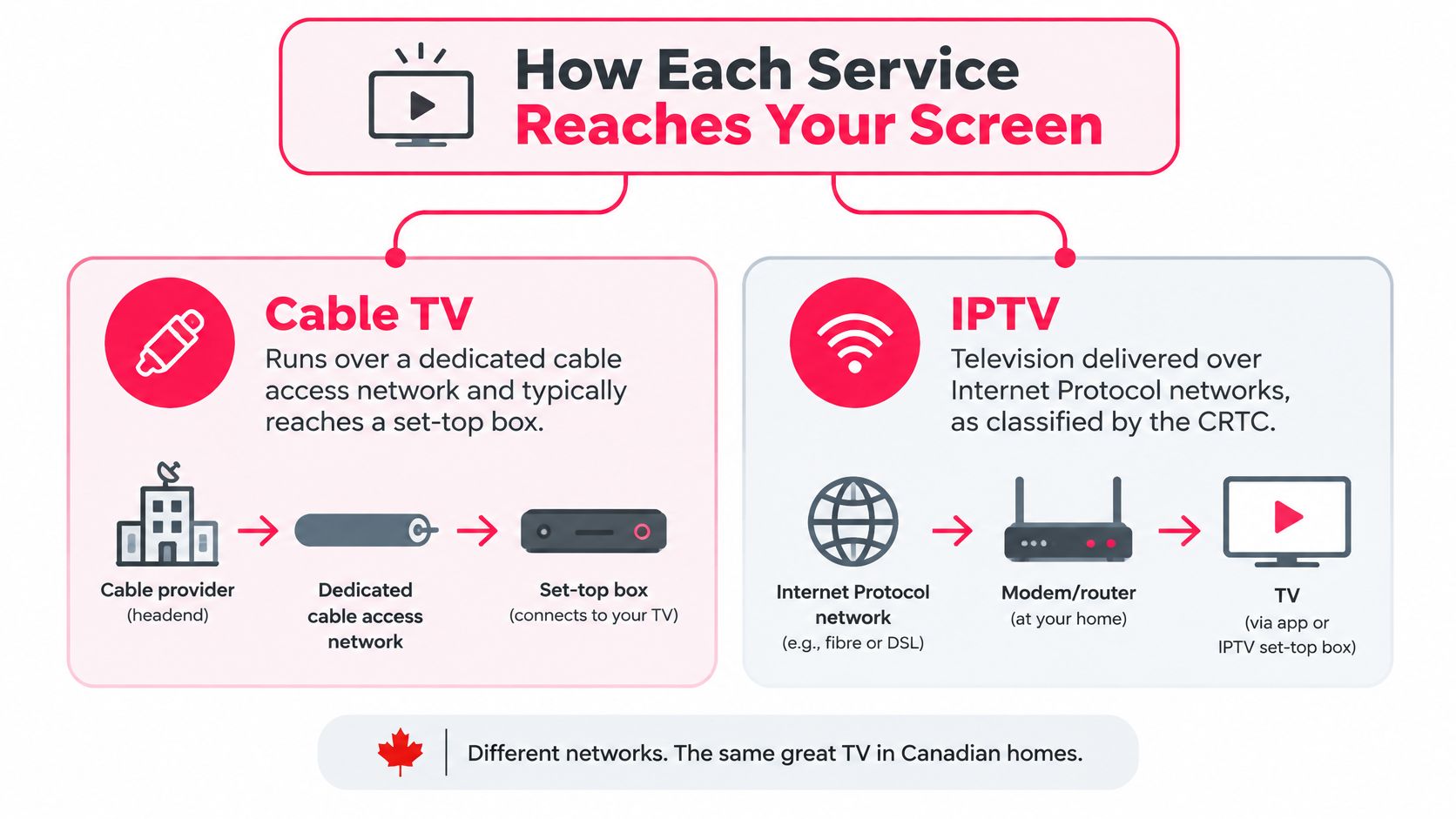
The distinction matters operationally. Bell Fibe TV and Telus Optik TV, the two services the CRTC report classifies as IPTV, run over each provider's managed IP network and still reach the television through a set-top box. That managed path is what enables the features cable viewers expect: an interactive guide, restart and catch-up, and network PVR that records on the operator's side rather than on a drive under your television.
What to check before you sign: peak-hour stability, set-top-box responsiveness, whether network PVR exists at all, and whether the simultaneous streams your household needs get real capacity.
Because IPTV quality is a function of the operator's access network and traffic engineering, two services with identical channel counts can perform very differently on the same street. A channel list is a weak buying signal; a test on your own connection during prime time is a strong one.
Three questions that sort a provider quickly
- Which network carries the stream? A provider running its own servers on fibre with load distribution behaves differently at 8 pm than one reselling capacity from a third party. ROVE IPTV, for example, runs its own servers hosted locally on optic-fiber internet.
- Is the distributor licensed for the content? Licensing separates a television service from a restream, and it determines whether a real support line exists when something breaks.
- What happens at peak hour? Ask how the provider handles simultaneous streams, and treat the advertised channel count as the weaker signal.
For the full mechanics, from encoding through middleware to playback, our guide on how IPTV works walks the path a channel takes before it reaches your screen.
Channel Access and Sports Coverage Compared
For a household that plans its week around the local NHL team, cable can be the simpler answer even when an IPTV subscription costs less on paper. That is the uncomfortable part of this comparison, and it belongs at the front rather than behind a channel count.
Cable channels follow the provider's lineup, which shifts by region. A subscriber in Winnipeg and a subscriber in Halifax can see different regional sports feeds inside packages that look similar in the brochure. IPTV lineups are set by the service instead. ROVE IPTV lists Canadian live TV channels, sports networks and live match coverage alongside movies, on-demand entertainment and international channel support, with sports highlights, replays and commentary programming included in the channel packages. Check whether a team's games appear in the lineup before you pay.
Canadian sports rights explain why. A 2025 Globe and Mail personal finance report on sports streaming costs found committed fans may need five or six subscriptions to follow the major men's and women's leagues, and documented Sportsnet raising its Premium annual price by 30% to $324.99 plus tax and its Standard package by 25% to $249.99.
Regional blackouts make that worse. A national or league streaming service can leave you blocked for your home team's games, which pushes you back toward the regional broadcaster and, often, back toward a cable package that carries it without a second app and a second login.
Cable is the option that bundles the regional feed you can't get legally at home without a second login.
Build your own sports basket
Do this on paper before comparing prices, because a generic sports basket is worthless.
- List every team and league your household watches, including the women's leagues, the national team fixtures and the one baseball package someone insists on.
- Name the rights holder for each one in Canada, then check whether that broadcaster sells direct or only through a distributor.
- Test your address against the blackout map. A postal code is enough to change the answer.
- Total the annual all-in cost, including tax, seasonal cancellations and any app you'd need on top.
- Confirm the service is licensed to carry the content, because IPTV describes a delivery method and never a guarantee of content rights.
That last check separates a legitimate subscription from an unregulated restream. If a service offers a full premium sports lineup for the price of a coffee, that is the tell.
Our IPTV channels list for Canada is the place to check whether the networks carrying your teams are in the lineup before you compare anything else.
Monthly Costs and the Full Bill in CAD
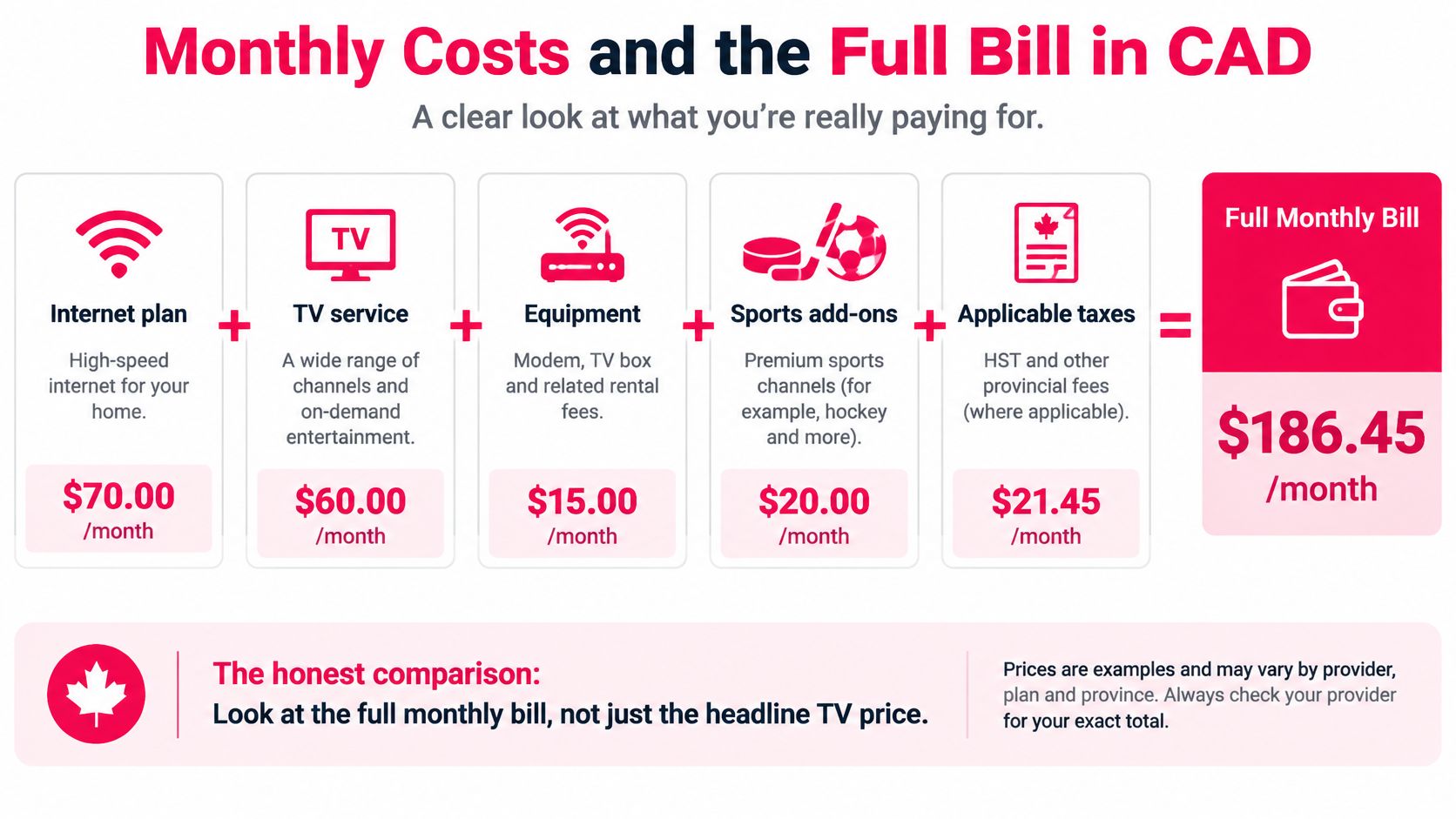
Compare the full formula: internet plan, TV service, equipment, sports add-ons and applicable taxes, less any bundle discount. Anything shorter than that is a promotional rate talking.
| Cost item | Typical cable bill | Typical IPTV bill |
|---|---|---|
| Internet plan | Often bundled with TV, sometimes discounted | Required and priced separately from the TV plan |
| TV service fee | Package price in a bundle, plus possible rental fees | Subscription plan price in CAD; taxes listed as included on the business site |
| Equipment | Set-top box, often rented monthly | Streaming device or box, usually bought once |
| Sports add-ons | Premium sports tiers or regional packages | Included only where the plan's channel lineup carries the rights holder; check the network list first |
| Contract and cancellation | Contract and early cancellation terms may apply | Plans advertised without contracts or automatic payments; confirm current terms |
| Trial and refund | Promotional pricing usually stands in for a trial | 24-hour trial without a credit card and a seven-day money-back provision advertised; verify before buying |
Cable bundles can lower the combined bill. The catch is that the discount usually arrives attached to a term, a receiver rental per television and an equipment return process when you leave. Add the rental for a second and third box and the "bundle saving" starts to look like a payment plan for hardware you'll never own.
Where the IPTV bill sits
An IPTV subscription doesn't replace your internet plan, it sits on top of it. That means the internet line has to be priced on its own, not as the discounted half of a bundle that disappears when the TV portion goes. If your current tier came with a bundle discount, expect that price to rise once the TV portion drops off, and factor in whether the connection needs a faster tier or an unlimited allowance to handle daily streaming.
Plans are listed in Canadian dollars with applicable taxes included, and subscriptions include low-cost access, flexible options, instant activation and secure payment methods. The site also advertises a 24-hour trial with no credit card and a seven-day money-back provision, so confirm both terms before you commit to anything longer.
A 1 Month IPTV Subscription Canada plan is the lowest-commitment way to price the TV line of the bill. The service carries thousands of live IPTV channels alongside movies and on-demand entertainment, with HD and Full HD streams, and the product page lists the current channel lineup and stream quality. None of that answers the internet question, which is why the monthly plan works as a test rather than a commitment.
A worked example to copy
Use your own numbers here. Say the internet line is $85, cable TV adds $80, two receivers add $20, a sports tier adds $25, and tax lands on top. That's roughly $210 a month before anyone rents a movie.
On the other side, the same $85 internet plus a subscription plan in CAD, with no receiver rental and no contract, is the number to beat. If the sports channels you need are already inside the subscription's lineup, the $25 add-on line disappears entirely. If they aren't, you may still owe a broadcaster directly, and the gap narrows. The difference only counts if it survives twelve months, not one promotional month. Our breakdown of IPTV subscription cost per month in Canada shows how to line the two up properly.
Internet Capacity and Data Use at Home
Every hour of IPTV arrives through your broadband connection, which is the single biggest structural difference from cable. The CRTC's communications monitoring report measured video consumption ranging from roughly 0.24–1.30 GB per hour for lower-bitrate CBC television streams to about 0.35–7.92 GB per hour for Netflix, with 4K capable of reaching approximately 5 GB per hour or more depending on encoding and bitrate.
At four hours of viewing a day, the monthly totals stack up fast.
| Stream type | Data per hour | Monthly at 4 hours daily |
|---|---|---|
| Lower-bitrate CBC stream | 0.24–1.30 GB | about 29–156 GB |
| Netflix stream (CRTC range) | 0.35–7.92 GB | about 42–950 GB |
| One 4K stream | about 5 GB or more | about 600 GB or more |
| Two concurrent 4K streams | about 10 GB or more | about 1.2 TB or more |
Monthly figures are calculated from the CRTC per-hour ranges above.
These measurements come from general streaming services rather than IPTV specifically, so treat them as planning ranges. They still give you the right order of magnitude. One 4K stream near the upper end eats a serious share of a monthly allowance before the rest of the household does anything, and a second screen running beside it can put a capped plan over the line on its own.
The hidden line item: cable's linear path doesn't touch your data allowance. IPTV does, and on a capped plan that's a bill item rather than a technicality.
What to check on your own connection
- Sustained evening download speed, measured at 8 pm on a weekday rather than at noon on a Tuesday. Advertised peak speeds are not the number that decides whether a stream holds.
- Wi-Fi coverage in the room with the television, since router placement does more for picture quality than a higher-tier plan does.
- Data cap and overage terms, especially in households running two or more screens at once.
- Upload speed matters far less than upload marketing suggests for watching; it matters for video calls happening at the same time.
A family with three televisions running different live feeds should plan for simultaneous streams rather than average use. Our guide to IPTV internet speed requirements sets out what each stream tier calls for per screen, which gives you a concrete target to test against during that 8 pm window. For a wider sense of how much of daily life now travels through a home connection, these global internet usage figures give useful context for sizing capacity.
Households that test at the busiest hour and size for concurrent screens rarely learn about their cap through an overage charge.
Device Flexibility and Everyday Viewing
Device range is where IPTV pulls clearly ahead for most households. We support Smart TVs, Android TV boxes, Amazon Firestick devices, smartphones and tablets, Windows laptops and Mac computers, and IPTV player applications. Confirm compatibility against the provider's current list before buying hardware, because a box that isn't on it is a paperweight with a remote.
Cable centres on the provider's box and whatever apps the provider supports, which caps the number of devices a household can use and often ties each extra television to a rental. IPTV spreads the same subscription across the screens people already own, which is why IPTV multiple devices setups matter more than raw channel counts for families with teenagers.
The service lists HD and Full HD channels, fast channel switching, stable servers, reduced buffering and consistent playback quality. Treat those as service descriptions rather than verified results, because your result depends on the network in your home.
Test it on your own setup
Run this before you commit to a longer plan.
- Open a live sports channel during the busiest evening hour, not a movie at 2 pm. Live is the hardest test a stream faces.
- Switch channels quickly, five or six times. Guide responsiveness tells you more about the platform than any feature list.
- Start a second screen on another device and watch whether the first one stutters. That single test tells you whether your household can run multiple televisions at once.
If a channel stalls or buffers
Work through these in order and note which one fixes it, because that tells you whether the problem is the network, the device or the service.
- Restart the app or set-top box first. A stale session causes more stalls than bandwidth does.
- Test over wired Ethernet where possible. If the wire fixes it, the issue is Wi-Fi coverage, not the provider.
- Move the router closer, or add a mesh node in the room with the television.
- Pause large downloads on other devices during the test, then repeat it.
- Reduce simultaneous streams, then add them back one at a time.
If the picture looks wrong rather than stalling, the steps to fix a slow smart TV cover the settings worth checking before you blame the stream. For households running several screens, our notes on IPTV multiple devices explain how connections are counted.
Choose the Right Option for Your Household
The right choice depends mostly on who lives in the house. The Angus Reid streaming survey, conducted in November 2026, found that only 50% of adults subscribe to cable or satellite, down from 71% in 2018 and 88% in 2012, while 84% subscribe to at least one streaming service, and the generational split is sharp: just 29% of adults aged 18–34 have cable compared to 77% of Canadians aged 65 and older.
A three-generation household can end up paying for two different services on one bill, which is why the full monthly cost, internet included, matters more than the headline TV price.

| Household situation | Likely better fit | Why |
|---|---|---|
| Local or regional sports fans on a fixed budget | Check the sports basket first; cable can be simpler | Blackouts and fragmented sports rights can raise the all-in cost |
| Multigenerational home valuing simple remote use | Cable in many cases; test IPTV first | Familiar guide and support; IPTV needs a quick on-screen test |
| Family with several TVs and streaming habits | IPTV, if internet capacity is strong | Multiple connections; data use and Wi-Fi must be planned |
| Multicultural viewers wanting international channels | IPTV, per the provider's lineup | International channels in one subscription; confirm each channel |
| Renters or movers who want no contract | IPTV | Plans advertised without contracts or automatic payments |
| Homes with unreliable or capped broadband | Cable | Linear TV does not use internet data allowance |
Four checks before you switch
- Calculate the full monthly bill, internet included, in CAD and with tax.
- Write the sports basket, team by team, with the blackout map checked at your postal code.
- Test the connection on the actual television in the actual room, not on a phone next to the router.
- Confirm the device list against the hardware you already own before buying anything new.
If the four checks come back clean, the trial described in the Monthly Costs section is the cheapest way to settle the argument on your own network.
When the trial holds up, match the plan to how many screens the household uses. ROVE IPTV offers flexible subscription options, so compare the current terms on the site and ask about device support or your sports lineup before subscribing. A three-month plan for two devices covers the common case of a living room plus a second screen, and it gives you a full season to judge the service rather than a single evening.
The households that end up unhappy are the ones that switched on the headline price alone, then discovered the regional sports feed was missing or that their internet could not carry two 4K streams at once. Do the full-bill maths first, then cancel cable with the numbers in hand.
ROVE IPTV SUBSCRIPTION CANADA delivers live Canadian and international channels, sports coverage and an on-demand movie library over your existing internet connection, with support for the smart TVs, Firesticks and mobile devices most Canadian homes already own. If the full-bill maths points toward IPTV for your household, visit ROVE IPTV SUBSCRIPTION CANADA to see current plans, check device compatibility and confirm the trial and refund terms for yourself.

No Responses